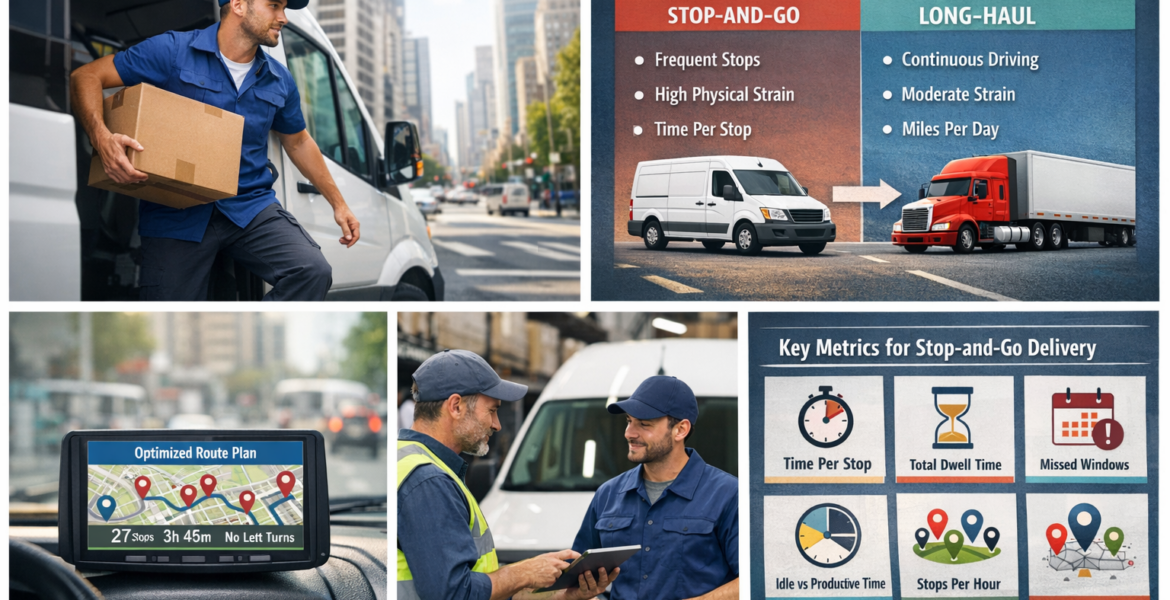
Frequent stop-and-go deliveries are one of the most challenging scenarios in logistics today. Local retail, urban distribution, and the last shipment all have this common problem: short distances, continuous halts, strict timing, urban congestion, and high pressure on fleets and drivers. Unlike long-haul trucking where the distance is the major factor, in this case, the performance measure is precise, consistent, and well-organized fatigue management.
Dealing with frequent deliveries well requires more than just driving experience. It is a matter of a purposeful delivery strategy which involves considering the stop density, route planning, appropriate vehicle, driver work overload, and honest delivery time expectations. This guide shows that truck operations can run the stop-and-go delivery conditions very well without compromising safety, efficiency, or driver retention — especially when handling deliveries in dense urban logistics environments.
Why Stop-and-Go Delivery Is a Unique Challenge in Truck Driving?
High-frequency stops create a workload pattern that is fundamentally different from that of highway driving. In retail delivery and last-mile distribution, the drivers can do 30 to 120 stops per shift, most of the time in urban areas with heavy traffic, where delivery challenges stack up quickly. Why Is Urban Last-mile Delivery So Difficult To Optimize? – Smart Logistics Network
Among the key difficult deliveries are:
- Breaking, idling, and acceleration
- Getting in and out of the cab
- Frequent meetings with docks, stores and customers
- Retail operations completely dependent on tight delivery windows
- Driver fatigue has increased, even though distances are shorter
So-called stop and start driving affects both drivers and delivery vehicles. Although mileage might not peak, physical and cognitive loads are high – thus delivery efficiency is more about flow control and less about speed.
Why Stop-and-Go Delivery Differs from Long-Haul Trucking
| Factor | Stop-and-Go Delivery | Long-Haul Trucking |
| Driving pattern | Constant stop and start | Long continuous runs |
| Physical workload | High (frequent cab exits) | Moderate |
| Mental load | High (navigation, timing) | Lower |
| Fatigue type | Cognitive + physical | Primarily physical |
| Performance focus | Time per stop | Miles per day |
High-Frequency Stops Route Planning
Effective route planning serves as the basis for stop-and-go delivery optimization. Poorly communicated delivery routes raise idle time, fuel consumption, and driver fatigue, while well-planned routes flatten stop density and ease potential stress.
Basic principles of practical route planning:
- Delivery grouping by micro zones, not just ZIP codes
- Routes with a left-turn-dominated direction to avoid congestion
- Sequencing of stops to minimize backtracking
- Aligning route direction with peak traffic patterns
- Factoring in realistic dwell times at each stop
For last-mile deliveries, route planning must be based on the actual field conditions and not on the theorized distances. For instance, a one-mile route in a core city can be longer than ten miles on the highway, especially in local delivery patterns with heavy stop density.
Managing Driver Fatigue in Stop-and-Go Operations
Driver fatigue in local deliveries is often oblivious due to the shifts being perceived as “short.” In real sense, frequent deliveries mean continuous physical and mental movement involving navigation, parking, unloading, paperwork, and customer interactions.
Fatigue risks in stop-and-go delivery:
- High cognitive load from navigation and timing pressure
- Repeated climbing in and out of the vehicle
- Constant attention resets at each stop
- Lack of long, steady driving periods for mental recovery
Stop-and-go routes should be scheduled as high-intensity shifts and not light duty as fleet management, break placement, and stop counts per route relate to performance and safety in delivery.
Choosing the Right Delivery Vehicles
Delivery vehicles are crucial in increasing the efficiency of the stops. The equipment intended for long-distance shipping usually performs poorly in city logistics.
Vehicle features for retail and last mile delivery:
- Automatic transmissions to decrease stop-and-start strain
- Good visibility and compact turning radius
- Side doors or liftgates for fast parcel delivery
- Fuel efficiency in idling and low-speed operation
- Easy cab access to reduce physical fatigue
A wrong delivery vehicle can easily wear down the drivers, miss the target on time, and hold up other deliveries aside from a well-planned route — which is a serious operational problem for any courier service network.
Delivery Time Expectations and Performance Metrics
Retail delivery performance should not be measured in terms of miles per day only. Instead, in stop-and-go environments, time per stop is a more precise metric.
Key performance metrics for efficient delivery involve:
- Average delivery time per stop
- Total dwell time per route
- Missed or delayed delivery windows
- Driver idle time versus productive time
- Stop density per hour
Practical Performance Metrics for Stop-and-Go Delivery
| Metric | What It Shows | Why It Matters |
| Time per stop | Operational efficiency | Identifies bottlenecks |
| Total dwell time | Route realism | Prevents overload |
| Missed windows | Planning accuracy | Affects retailer trust |
| Idle vs productive time | Utilization | Highlights inefficiencies |
| Stops per hour | Route density | Controls fatigue risk |
Clear metrics help fleets to avoid unwanted expectations that push drivers on roads that are not safe.
Retail Delivery in Urban Logistics Zones
Urban logistics add new constraints like parking restrictions, pedestrian traffic, and enforcement pressure. Hence success in local deliveries depends more on predictability, compliance, and less on speed.
The most efficient practices consist of:
- Approved delivery time windows with retailers
- Standardized unloading procedures
- Clear communication between dispatch and drivers
- Buffer time for congestion and access delays
Retail delivery often lies in the coordination rather than just the driving skills of the driver. When routes are planned with local regulations and access limitations in mind, drivers spend less time resolving conflicts and more time completing deliveries smoothly and safely.
Delivery Optimization Without Overloading Drivers
Delivery optimization should aim to reduce friction rather than shifting the pressure on to drivers. Jamming many high-frequency stops in a single route will drive the drivers up the wall, make them add more errors, and push them to turnover.
Balanced delivery plans include:
- Capping stop counts per shift
- Designing relief routes for peak days
- Rotating high-intensity routes among drivers
- Using data from previous runs to refine planning
Sustainable delivery is the result of efficient delivery. Any optimization that disregards human limits is bound to affect the fleet negatively — even when fleets invest in modern last mile solutions.
Stop-and-Go Delivery as a Fleet Management Discipline
Fleet management in last mile solutions is all about controlling the variables present. Adding frequent deliveries will amplify the small inefficiency arising from poor routing, inadequate communication, and unfeasible timelines.
Healthy fleet management is characterized by:
- Consistent route structures
- Clear delivery expectations
- Equipment matched to task
- Driver feedback loops
- Continuous adjustment based on real delivery data
In stop-and-go operations, discipline matters more than improvisation. Fleets that standardize processes, listen to driver input, and refine routes incrementally maintain stable delivery performance even under high stop density and daily operational pressure. This approach reduces errors, limits burnout, and supports long-term driver retention.
Retail and parcel-find delivery systems think, not force.
Conclusion: Final Mile Mastery
Stop and go delivery is one of the most difficult forms of truck driving. Not because of the distance but rather the intensity. The key to frequently delivering is to plan properly the routes, manage the time expectations realistically, use the right vehicles, and respect the driver’s fatigue.
When logistics operations regard the last mile delivery as a high-skill discipline, logistics performance rises automatically. Efficient delivery is never about rushing – it’s about mastering the rhythm of both starting and stopping the process, step by step, mile by mile.
In modern trucking, the final mile is the most blatant exposer of professionalism.
FAQ: Retail and Last-Mile Stop-and-Go Deliveries
What factors cause stop-and-go delivery to be more complex than long-haul truck driving?
Stop-and-go delivery requires continuous braking, idling, parking, unloading, and communication at every stop. Even though the distances are shorter, the physical and mental stress are increased due to the inserted stop-and-go cycles, short delivery time frames, and urban logistics limitations.
Per shift, how many stops would be classified as high-frequency delivery?
The high-frequency delivery rate for a typical route is usually at least around 30 stops per shift and could extend to over 100 stops in case of dense local delivery or retail routes. In this case, it is vital for delivery performance and safety the management of routing, vehicle selection, and fatigue.
Why is route planning of such significance for last mile delivery?
Last mile delivery weight reality more than distance. Mistakes in route planning lead to time spent idling, excessive fuel costs, and driver tiredness. Proper delivery routes counter backtracking, achieve better stop density completion, and consider traffic inefficiencies, shifting deliveries toward predictability and sustainability.
In what ways do stop-and-go driving contribute to driver fatigue?
Frequent deliveries bring about fatigue due to repeated entry/exit of the cab, constant attention shifts, and the lack of consistent driving time. This type of fatigue is not only physical but also mental, thus the management of stop-and-go routes should be treated as high-intensity shifts in the fleet.
What kind of vehicles would be fit for retail and local delivery?
The vehicles utilized for retail and courier service operations need to have features emphasizing the opening of the cab, visibility, small turning radius, and low-speed performance. The ones designed mainly for long-haul driving usually do not perform in urban logistics and high-frequency stop environments very well.
What is the targeted measure of performance in stop-and-go operations delivery?
Miles covered in a day is not a good metric for stop-and-go delivery due to various reasons. The more credible indicators are time spent at each stop, total dwell time, stop density by hour, and missed delivery windows. These variables parallel the actual delivery troubles and push delivery optimization to the next level.
Can delivery optimization lead to an increase in efficiency without drivers becoming overloaded?
Yes, but solely under the condition that the optimization will respect human limits. The capping of stops in a single shift, rotation of demanding routes, and adjustment of plans depending on real delivery data, all contribute to the improvement of efficiency without the increase of driver turnover or safety risks.
Leave a Reply