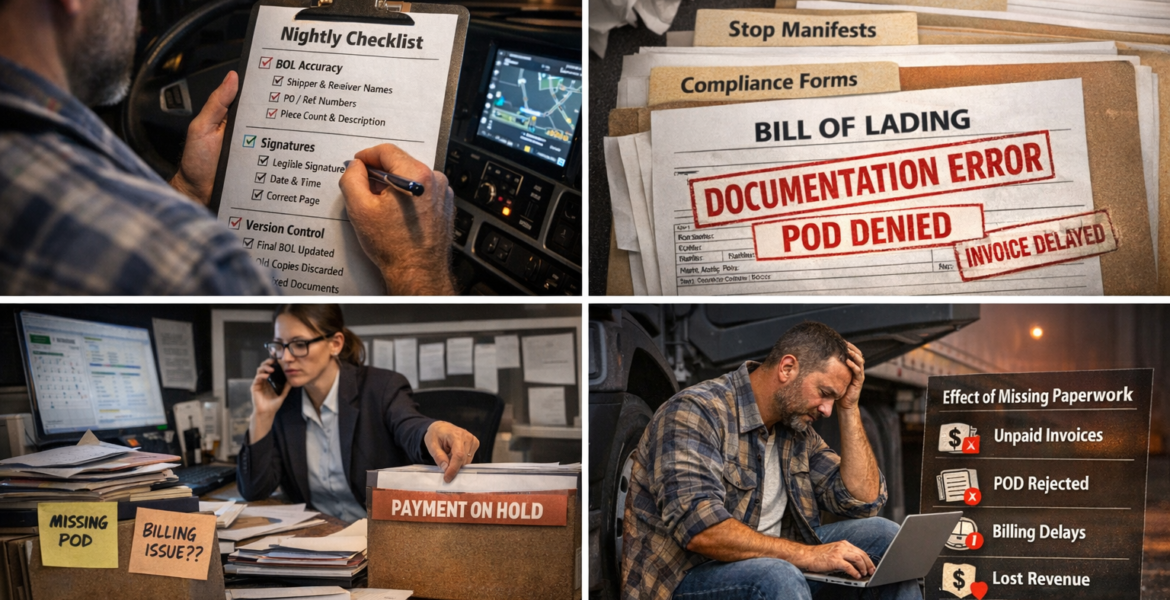
Frequent stops are the boredom of floating paper files of the failing AS-IS certified non-profitable freight runs. For multi-stop route drivers such as LTL, regional, or urban distribution, paperwork errors often do not occur at noon — they occur late at night, fatigue, repetition, and the assumption taking over, especially when you are running frequent delivery points back-to-back.
A missing signature, a wrong Bill of Lading version, or understanding of receiver rules does not stop immediately the truck. Alternatively, it appears later as delayed payments, rejected PODs, compliance problems, or refused freight. That is the reason why a nightly checklist for BOL and receiver documentation is not an administrative routine but rather a proper defensive tool built around BOL rules and consistent documentation control.
The write-up contains a practical guideline for a nighttime documentation checklist for drivers with multiple delivery stops. It dwells on what has to be checked at night before the next day begins, while mistakes are still fixable.
Reasons for Increased Documentation Risk at Frequent Stops
Freight businesses with multi-stop deliveries face the threat of paperwork overexposure. Each delivery generates new potential problems:
- Different receiver requirements
- Different signatures needed
- Different formats for documents
- Different delivery procedures
Just one overlooked thing increases the effects through the route. A driver who manages ten stops is not dealing with ten times the paperwork — they are dealing with ten different compliance environments, and those environments become harder to manage as frequent stops stack up.
It is critical to do the nightly review because it is the only time when one can really correct the documentation before the errors become permanent records in the system.
The Multi-Stop Freight BOL Contribution
The bill of lading (BOL) is not just a shipping document. It is a legal record, a payment trigger, and represents compliance.
In frequent-stop freight haulage, it comes with problems like:
- Utilizing a master BOL instead of split BOLs
- Lacking receiver-specific references
- Mistaken piece counts post partial deliveries
- Signatures on either the wrong page or the incorrect copy
Sometimes customers have varied carrier rules, like in the case of some receivers who ask for stamped BOLs, others who accept digital signatures and some who wait for handwritten time-in/time-out entries. Taking these rules as uniform across stops is an automatic warning and a direct violation of site-specific BOL rules.
Adjustments can’t be made to these assumptions due to the presence of checklist.
Nightly Checklist: Adjustment of Core BOL Verification
Every night — before sleep, before paperwork submission, before logging off — look again at:
BOL Accuracy
- Correct shipper and receiver names
- Matching PO or reference numbers
- Accurate piece count after each stop
- Correct freight description
Signature Integrity
- Legible receiver signature
- Printed name (if required)
- Date and time recorded
- Signature on the correct BOL page
Version Control
- Final BOL reflects delivered quantities
- Old copies clearly marked or discarded
- No mixed versions in the document stack
This one single step eliminates a large proportion of rejected documents and payment postponements on routes with frequent stops.
Receiver Rules: The Silent Variable
No set rules usually exist for receiver rules. Some locations may enforce different delivery rules even within the same company, especially across frequent delivery points that appear similar on paper but operate differently in practice.
Examples of receiver-specific documentation rules are:
- Mandatory arrival/departure time stamps
- Separate manifests for each dock
- Special annotations for damages or shortages
- Attached photos required for receiving documentation
Drivers often miss the nightly verification and think that they will remember the things that they forgot. Truth is that our memories don’t always stay fresh when we load stops together, especially during frequent stops.
A nightly checklist guarantees that:
- All receiver’s rules were followed
- Exceptions are marked without any question
- Missing items were flagged at the right time to make corrections possible
Manifest and Stop-Level Documentation Review
Manifests serve as the guidance system for the paperwork on multistop routes.
Nightly manifest checklist:
- All stops marked completed or pending correctly
- No skipped or duplicated stop entries
- Delivered quantities match records in the manifest
- Exceptions clearly noted (refusal, shortage, damage)
This step aligns the manifest with the BOL and receiving documentation, preventing conflicts between systems later.
Trucking Shipping Documents, BOL & Freight Paperworks
Compliance Checklist: Adhering to Carrier and Shipping Regulations
Carriers also have rules and shipping regulations that must be observed beyond the receiver rules. This is where a nightly compliance checklist becomes the only reliable filter before errors become billing disputes.
Nightly compliance review should include:
- Documents required to be present for each stop
- Hazmat or special handling paperwork which is attached (if applicable)
- Temperature logs which are related to the deliveries
- Digital uploads completed (if required by carrier policy)
This is particularly necessary for drivers, who work under rigorous logistics documentation standards. A single document carried away can tarnish the whole invoice.
Nightly Documentation Checklist for Frequent Stops
| Checklist Item | Why It Matters |
| BOL accuracy | Prevents invoice rejection |
| Receiver signatures | Confirms legal delivery |
| Stop-level manifests | Avoids mismatch disputes |
| Receiver rules compliance | Prevents refused PODs |
| Exception notes | Protects against claims |
| Carrier documentation | Ensures payment processing |
Why Nightly Review Works Better Than Morning Fixes
Morning checks fail because:
- Receivers are no longer available
- Dispatch is already scheduling
- Memory gaps appear
- Corrections require phone calls instead of pen strokes
Nightly review happens when:
- The day is complete
- Details are still clear
- Errors are still correctable
- Documentation discipline is strongest
In daily freight routine, night is the only quiet window where accuracy beats speed.
Fostering the Habit in the Truck Driving Workflow
This checklist should not feel like extra work. It should become part of shutdown procedure — like post-trip inspection.
Successful drivers treat documentation as cargo:
- If it’s damaged, payment is damaged
- If it’s incomplete, delivery is incomplete
- If it’s late, revenue is late
In freight operations, paperwork discipline separates smooth weeks from chaotic ones.
The Unnoticed Price of Omitting the Nightly Documentation Discipline

One of the most misjudged risks in freight operations that involve lots of stopping is not the physical workload but the financial dropout created by inseparable documentation mistakes. When drivers forget to fill out the nightly checklist, the loss of cost is seldom immediate. Instead, it occurs days or weeks later as a result of unpaid invoices, disputed additional charges, rejected PODs, or a tireless cycle of exchanges with accounting departments.
Every missing or incorrect paper affects everybody in the chain. Dispatch spends time clarifying what has happened. Accounting may postpone the billing or may flag this load as non-compliant. Brokers will doubt service quality. The receivers will pass the buck to the carrier. The process begins as a simple paperwork error but evolves into a persistent issue that wears away the revenue without any noticeable “incident” on the road.
This is particularly common on routes with a lot of delivery points where the total volume undermines efficiency. A driver may finish the route with success, get all the docks right and move to the next load- all the while the undocumented from yesterday was blocking payment. Gradually this situation leads to cashflow difficulties that drivers often confuse for “low rates” or “slow brokers,” while the real issue is the discipline of internal paperwork.
There is also a cost of behavior. When it becomes a norm for drivers to do elevation issues, they think it is a part of the job. Missing signatures become “minor.” Incomplete manifests are “fixable later.” This mentality drives the industry;s quality standards down and consequently, the exposure also increases at every following course. Eventually, even well-paying freight becomes a losing proposition due to the leaks of administration.
A nightly checklist serves as a reset point. It separates the work done today from the problems that will happen tomorrow with a solid boundary. By closing the document loops at night, the drivers not only preserve a single load but also the whole operational credibility. In freight operations, the consistency of paperwork is as important as driving consistency which is sometimes more beneficial in the long term.
Final Observations: Documentation As A Profit Skill
Nightly BOL and receiver documentation checks are not mere clerical operations — they are safety net tools for income.
Frequent stop truck drivers with neglected paperwork discipline often pass the blame to brokers, carriers, or accounting departments. The truth is that most documentation issues are erasable with just ten peaceful minutes at night.
In truck driving, miles give freight movement and documentation, in turn, gives money movement.
Consistent use of a nightly checklist can turn paperwork from a liability into your control.
FAQ: Nightly Management List of BOL and Receiver Rules Documentation for Regular Stops
Why is it essential to have a nighttime checklist for frequent stops?
Frequent stops increase the documentation risk. Each delivery point may have its own BOL rules, delivery procedures, and signature requirements. The nightly checklist serves the purpose of the drivers to catch mistakes while everything is still fresh, before they transform into rejected paperwork, delayed payments, or compliance issues.
What are the necessary documents to check every night?
At the very least, the drivers will go through the bill of lading, stop-level manifests, receiver signatures, exception notes, and any carrier-required forms. When hazmat or temperature-controlled freight is involved, those logs also should be checked in the compliance checklist.
How can a nightly review help to avoid payment delays?
A large part of the payment delays occurs because of the missing signatures, BOL versions are wrong, or the ingredients are mismatched with the different delivery points. Checking at night ensures that the mistakes will still be corrected while the receivers or dispatch are reachable.
Do the receiver regulations differ that much between stops?
Yes, they do. Even a location under the same brand may apply different delivery procedures. Some need scanned BOLs, others digital signatures, photos, or handwritten timestamps. The most frequent error in documentation is to assume that all the rules are the same at all points.
How long does it take to fill out the nightly checklist?
In reality, only 5–10 concentrated minutes are needed. That fast routine is the one that often prevents days of billing disputes, unpaid detention, or refused PODs later.
Leave a Reply