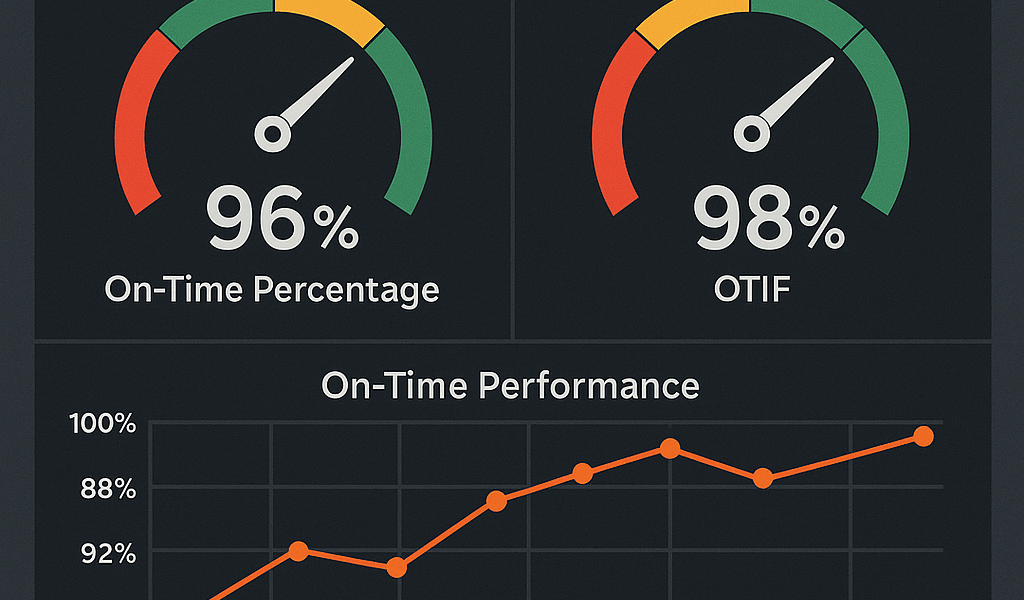
The efficiency of dry van delivery operations is dependent on having a clear view of performance. Milwaukee shippers depend on a mix of dry van delivery KPIs, Milwaukee shipping metrics, and a user-friendly shipment dashboard to maintain freight conveniently. No matter if you are a regional carrier or a third-party logistics provider, keeping an eye on the right metrics is the way to identify the bottlenecks, save money and enrich the customers’ experience. Through this article, we would like to tell the most important things about metrics that every shipper should pay attention to, from on‑time percentage to exception rate, and how a centralized dashboard puts everything in an easily understandable view.
The Importance of Tracking Metrics
Performance metrics tracking is not only an administrative issue but also is the core of the continuous improvement process. The measurement of OTIF (on‑time in full), dwell time, or detention hours provides you with the necessary information to make actions:
- Delay identification: Observe the trend in the late arrival of pickups or deliveries and address them before they grow out of control.
- Resource use optimization: Proper estimation of load factors and fuel consumption leads to savings on transportation runs.
- Improved carrier accountability: A transparent carrier score makes sure partners like HMD Trucking behave accordingly.
- Customer trust advancement: Sticking to deadlines on a consistent basis results in an increased on-time percentage which, in turn, raises your reputation.
By zeroing in on the proper metrics combination, Milwaukee shippers can manage city traffic patterns, space constraints in warehouses, and seasonal demand fluctuations, all of which are vital in the scenario of accuracy being indispensable in the market.
A Bird’s Eye View of the Typical Metrics
Before we delve into more details, here’s a snapshot of the main indicators you should take into consideration:
| Metric | Definition | Why It Matters |
| On‑Time Percentage | Share of deliveries completed by the scheduled time | Measures reliability of carriers |
| OTIF | Share of shipments delivered complete and on time | Captures full-service performance |
| Dwell Time | Time a trailer sits idle at pickup or drop-off | Highlights loading/unloading inefficiencies |
| Dwell Cost | Expense incurred per hour of idle time | Quantifies cost impact of dwell time |
| Detention Hours | Extra time a carrier is held beyond the agreed unloading window | Directly drives up carrier charges |
| Turnaround Time | Total time from departure to return | Reflects overall fleet utilization |
| Miles per Gallon | Average fuel efficiency per load | Key for fuel budgeting and sustainability |
| Load Factor | Percentage of vehicle capacity actually used | Optimizes cargo weight versus available space |
| Carrier Score | Composite rating of carrier performance (e.g., timeliness, claims) | Guides carrier selection and negotiation |
| Exception Rate | Frequency of shipments requiring special handling or rerouting | Signals operational disruptions |
On‑Time Performance: On‑Time Percentage & OTIF
Two of the most frequently used Milwaukee shipping metrics are on‑time percentage and OTIF. On the one hand, On‑time percentage only measures the deliveries arriving on time as a share of all scheduled deliveries, while OTIF goes a step further requiring the right items to be delivered undamaged and complete. A high on‑time percentage (e.g., over 95%) is an evidence of excellent punctuality, but without OTIF, you can overlook some underlying issues, such as partial shipments or product damages.
The formula for calculating the on-time percentage is:
On‑Time % = (Number of deliveries on time / Total deliveries) × 100
And the OTIF is:
OTIF = (Deliveries on time and in full / Total deliveries) × 100
Not infrequently, when shippers calculate these, they use for example, the monthly target settings of 97% on‑time percentage and 95% OTIF and review them with a shipment dashboard to quickly highlight the non-performing lanes or carriers.

Efficiency Monitoring Metrics: Dwell Time, Dwell Cost, Detention Hours & Turnaround Time
Idle trailers shorten the profits. Dwell time measures the duration of time while a dry van is parked at a facility before loading or after unloading. By calculating scores of idle time versus the average operating costs per hour you can determine dwell cost, that will help you understand the financial implications of inefficient processes.
- Dwell Time: Total idle hours ÷ Total stops
- Dwell Cost: Dwell Time × Hourly Cost Rate
To illustrate, if a van operates at $50/hr and remains idle for 4 hours, that’s a $200 dwell cost — money that could’ve been spent on revenue-generating miles.
Detention hours occur when a carrier is retained longer than the initially agreed time for loading or unloading. These detention hours also result in penalties applied and can be checked out on the same dashboard. Lastly, the term turnaround time is used to cover the entire distance starting and ending with the departure, as it covers driving times, loading and waiting ones. By reducing the turnaround time, shippers assure that trucks can make more trips within the same period, that way increasing overall productivity.
Productivity Metrics: Miles per Gallon & Load Factor
Gasoline is one of the top variable costs for dry van operations. Miles per gallon (MPG) is a commonly accepted measure of fuel efficiency. Keeping track of the average MPG of the Milwaukee lanes within your network of partners assists in identifying inefficient routes or vehicles in neglected states. For instance, a sudden decline in MPG can point to mechanical problems or changes in driving behavior.
Load factor (the percentage of the available cubic or weight capacity you actually use) is an excellent complement to MPG data. A 90% load factor on a dry van caught you with nearly full loads; anything below 75% may require route consolidation or bagging changes to fill up space to the maximum. Together, MPG и load factor are a guide for route planning, vehicle repair and carrier selection.
Quality and Risk Metrics: Carrier Score & Exception Rate
Not all the carriers have the same efficiency rates. A comprehensive carrier score encompasses a whole range of risks: for example, timeliness, claim frequency, safety records, clots, and others. Shippers rate the performance of their carriers, in this case, basis the score they would decide to redirect volumes, or the best suppliers, or drop their services. For instance, HMD Trucking https://www.hmdtrucking.com/truck-driving-jobs/dry-van-lease-purchase-atlanta/ might be the partner with a 4.8/5 carrier score that is a reflection of its consistent performance in US’s challenging urban corridors.
The exception rate shows the proportion of shipments that had unexpected things happen to them: for instance, there were times the goods were missed, were damaged or paperwork covered them. When calculating the exception rate, the formula is as follows:
Exception Rate = (Number of exceptions / Total shipments) × 100
An increasing exception rate implies systemic problems such as deficiency in skills or technological faults which should be addressed without delay.
Constructing a Functioning Shipment Dashboard
The shipment dashboard is the center of all the KPIs which are tracked. What an ideal dashboard for Milwaukee dry van deliveries should consist of is:
- Real-Time Data Feeds: Connect to your TMS and ELD systems for live updates on location, ETA, and driver status.
- Visual Gauges and Trend Lines: Display on‑time percentage and OTIF as easy‑to-read gauges, with trend lines showing daily, weekly, and monthly performance.
- Heat Maps and Route Analysis: Identify Milwaukee hotspots where dwell time spikes or exception rates climb.
- Custom Alerts: Set thresholds — for example, dwell time exceeding two hours triggers an email to the operations team.
- Drill‑Down Capability: Click on a metric like detention hours to see which carriers or facilities are the culprits.
Through the periodic clean-up of Milwaukee shipping metrics shippers and 3PLs can work on their performance, carbon emissions, and decision-making, and be more effective in their response to sudden disruptions.
Best Practices & a Real‑World Case Demonstration
- Set Clear Benchmarks
- Define target ranges for each KPI. For example, aim for an average dwell cost under $100 per stop and an exception rate below 2%.
- Define target ranges for each KPI. For example, aim for an average dwell cost under $100 per stop and an exception rate below 2%.
- Review Metrics Regularly
- Hold weekly performance review meetings. Involved parties such as carriers like HMD Trucking should be kept in the loop and be able to discuss trends, and suggestions for corrective actions.
- Hold weekly performance review meetings. Involved parties such as carriers like HMD Trucking should be kept in the loop and be able to discuss trends, and suggestions for corrective actions.
- Leverage Automation
- Use the automation of data collection from GPS trackers, ELDs, and warehouse management systems to eradicate manual errors.
- Use the automation of data collection from GPS trackers, ELDs, and warehouse management systems to eradicate manual errors.
- Continuous Improvement Cycles
- Use metrics as the basis for Kanban events — very short workshops that focus on one area (e.g., reducing detention hours at a high-volume Milwaukee terminal).
- Use metrics as the basis for Kanban events — very short workshops that focus on one area (e.g., reducing detention hours at a high-volume Milwaukee terminal).
The case overall is about a Midwest shipper that pointed out an increase in detention hours in Q1. The break down of the data presentation on their shipment dashboard led them to the discovery that two partner warehouses were running shifts that ended before afternoon arrivals. In turn, the two sites worked on adjusting loading schedules which saw an average workload cutting of 1.5 man‑hours on each load, which sequentially totaled into a $15,000 annual worth of savings.
Conclusion
The Milwaukee dry van market is dynamic, and the metrics to determine whether a company is meeting customer expectations or not are basically the same. By measuring dry van delivery KPIs — from on‑time percentage and OTIF to dwell time, miles per gallon, and exception rate — shippers are able to gain clarity in their search for optimal operations. A central and efficient shipment dashboard consisting of all those metrics becomes a great tool for, not only collaboration but also, cost control and continuous improvement. Start measuring today, partner effectively (think HMD Trucking and other top carriers), and watch your delivery performance hit new highs.
Want a Visual Example?
Check out this helpful explainer video:
6 Key Metrics to Include in Your Logistics Dashboard
It explains the essential performance KPIs and provides an example of how to design your logistics dashboard in order to gain practical insights.
Leave a Reply