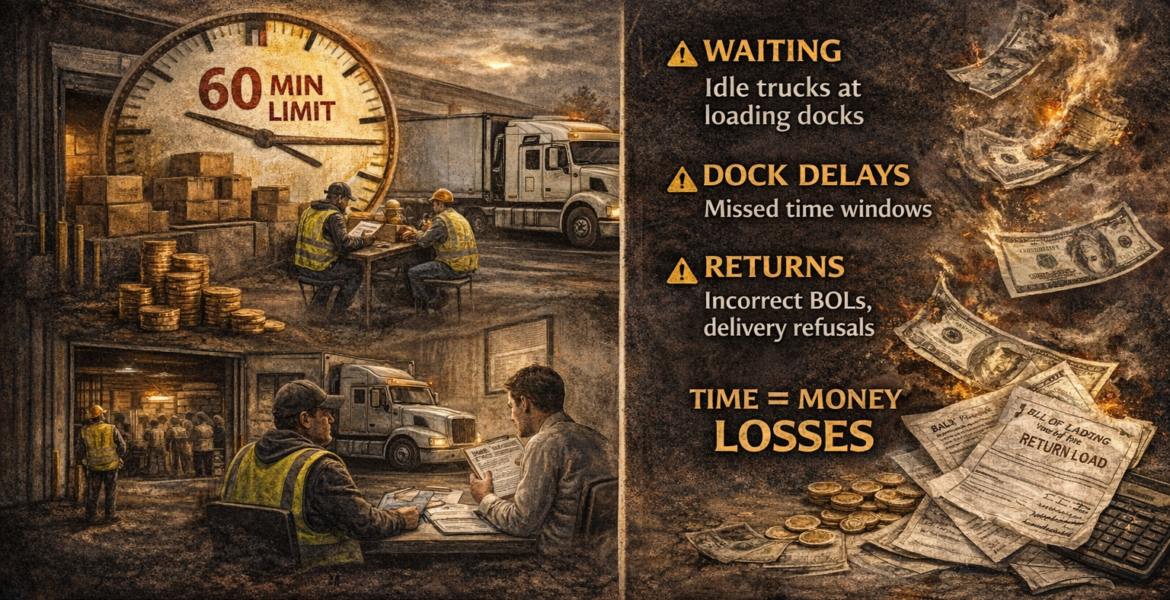
Short haul freight is commonly thought to be faster, cheaper, and more straightforward than long-haul operations. Short distances, unconstrained routes, and repetitive turns of the thought are all assumed risk-cutting factors. Unfortunately, short haul logistics camouflages some of the toughest-to-address trucking industry issues, freight loss being one of them at times. With money not lost on the road, it is spent mainly at loading docks, and during freight returns apart from free time — and this is where money wasted becomes an operational pattern.
In short haul trucking, profit margins are lower, and the duration of cycles is shorter. This means that the inefficiencies that arise compound quickly. Thus, a single dock delay, a missed appointment, or even a return load can rob from the amount of money made from many deliveries altogether. Unlike long-haul freight, there is usually no sufficient number of miles accrued to make up the mistake.
This article details the actual loss at short-hail freight operations from excess freight waste, in three instances: the time to wait is dock delays and freight returns. We discuss how these issues arise, their incorrect estimates, and the basic reasons of the decisive things supervisory the carrier on transportation. If you are any personnel in truck driving, fleet management, or freight management, these ideas are not theorized, they are part of the operational accounting.
Hidden Losses: Why Short Haul Freight Has More Exposure to Them
The main frame of the short haul freight cargo makes the branch turn into uniquely reliant in trucking inefficiency. The number of trips it usually has is smaller, but it has more such trips a day. Adding more moops, more docks, more paperwork, and more handoffs which is why the number of points of failure is higher.
The fuel, the miles, and the driver hours are the dominating factors in long-haul operations. The time variable becomes the most costly in short haul logistics. When the trucks stop moving, the revenue stream stops immediately. If the run is 120 miles long bus stops at a loading dock for 45 mins that does not make much sense that operational spell potential of the daily earnings.
Another parallel that needs to be drawn is heavily with warehouse operations. For example, urban congestion at delivery points, inefficiencies of choice labor, and inconsistently applied protocols tend to compound on delays. These delays are rarely compensated fully through carrier detention, especially for LTL freight or less than truckload shipments where responsibility is fragmented.
Another area where our freight cost drivers face challenges is pressure outside. The drivers need short-haul transporters to be mostly heavily charged. In any case, a disruption such as lost paperwork, bad load quotes, or damaged cargo may force the above-mentioned alternatives i.e., rerouting, returns, or rescheduling. Each of these incidents can increase the transportation costs without any corresponding revenue increase.
To make a long story short, short haul freight is not low risk. It is a frequent exposure to small losses that accumulate quickly.
Waiting Time: The Most Silent Freight Loss Reason
Among all losses, waiting is the most underestimated point in short haul trucking. Drivers wait for docks, review paperwork, do yard shifts, confirm loads, or get release numbers. At first glance, these delays are trivial all alone. The truth is they squander a huge amount of money across whole fleets, turning idle hours into ongoing money wasted.
Usually, the waiting time becomes the only time when the employee is unpaid or underpaid. Carrier detention policies maybe just come into play after the previous time limit is reached (which is oftentimes 2 hours), and even then the compensation is hardly ever what it should be to reflect the true cost of productivity lost. For short-haul routes that take in several stops, one delay a day could be a missed appointment for a doctor the whole of rest of the day.
Driver behavior is also quite heavily influenced by waiting. When drivers expect delays, they change efforts, speed up unloading, or skip breaks to meet the scheduled time. These adaptations lead to more consumer errors like wrong delivery, cargo damage, or even safety incidents that create secondary losses, including avoidable shipping errors.
From a perspective of fleet management, waiting destroys the utilization of assets. The trucks can only make money when they are running. A truck that is docked is a depreciating asset with no income. This situation leads to a higher cost per mile in the long run, escalated freight quotes and to the loss of competitiveness. Waiting is not merely a scheduling or planning problem, it’s a problem for profit.
Dock Delays: Where Short Haul Profits Run Away
Dock delays are easily the most visible loss point in short haul operations, although they are also the most normalized ones. In many circumstances, delays in the supply chain have been viewed as a matter of course. That kind of thinking is costly.
Understaffed, poorly sequenced, or overloaded during peak hours; loading docks tend to be the very reason behind this. In the case of short haul, this is a time where speed is critical, and it creates traffic jams at precisely critical times. This means a delay at the first delivery point directly affects the other deliveries.
In addition to that, the dock delays raise logistics costs through increased inefficiencies:
- Extended engine idle time
- Increased driver on-duty hours without mileage
- Higher likelihood of missed delivery time windows
- Increased exposure to traffic congestion later in the day
What is Happening to ALL the Freight?! (Layovers, Waiting Time, Dispatch Delays)
LTL freight, or any other freight that has combined loads, is more affected by dock delays. Mixed loads need to be properly sequenced, documented, and handled; any breakdown in dock coordination increases the risk of either freight damage or misrouting.
Another unobserved factor is accountability. Generally speaking, dock delays fall into the “not the shippers’/not the warehouse’s/not the carrier’s issue” zone. Without any performance metrics, no party feels responsible, hence the carrier bears the cost.
However, in short-haul trucking, dock delays are not the operational errors, but the structural breaches in profitability.
Main Money Loss Points in Short Haul Freight
| Loss Point | How It Occurs | Financial Impact |
| Waiting time | Dock queues, paperwork delays | Lost productivity, unpaid driver time |
| Dock delays | Understaffed or mismanaged loading docks | Missed appointments, higher costs |
| Freight returns | Delivery refusal, damage, errors | Double mileage, lost revenue |
| Paperwork issues | Incorrect BOLs, missing signatures | Payment delays, disputes |
| Cargo damage | Rushed handling, poor staging | Claims, customer loss |
Freight Returns: The Most Expensive “Second Trip”
Freight returns are one of the most destructive loss points in short haul logistics. In contrast with waiting or delays, returns create immediate and visible losses but they in fact stem from errors that could have easily been avoided.
The most common reasons for freight returns are:
- Incorrect freight paperwork
- Delivery refused due to missed time windows
- Cargo damage at docks
- Misquoted freight specifications
- Errors in last mile delivery coordination
Return loads are a double whammy for the carrier. They handle it one time but don’t get paid for the return. The carrier incurs extra costs for fuel, driver time, tolls, and scheduling disruption. In some cases, the customers also implement penalty clauses or there is a turnover of customers, especially when expedited shipping expectations are involved and disruptions become intolerable.
Returns, especially for less than truckload shipments, are even more problematic. Disputes about accountability might arise between warehouse operations, carriers, and brokers. However, while liability is debated, the truck still moves – unpaid.
With Returns being an issue, logistics might also suffer. It can lead to customers being unhappy, not trusting the company anymore, etc. In other situations, the returns are so frequent that they cause the carriers to raise their freight rates to compensate for the uncertainty and this makes them less competitive in the freight industry.
In short haul freight, it is more often than not the case that preventing returns turns out to be more profitable than simply boosting volume.
Freight Paperwork: Minor Errors, Massive Costs
The well-oiled machine of short haul logistics is driven by paperwork, the connective tissue of the system. Yet, paperwork is one of the weakest points of the whole system. Errors in bills of lading, delivery confirmations, or accessorial documents frequently lead to delayed payments or denied claims.
In the high-frequency of short haul activities, paperwork comes in great volumes. Drivers may handle dozens of documents during a shift that is hard to make. Under time pressure, mistakes happen:
- Missing signatures
- Incorrect piece counts
- Wrong delivery addresses
- Mismatched freight classifications
These errors ripple through the supply chain. Invoices are delayed, detention claims are rejected, and disputes consume administrative resources. Though these costs may not seem to appear on a fuel report, they do accumulate as tangible transportation expense.
Effective freight management treats documentation accuracy as more than just a bureaucracy issue it is a way of protecting revenue.
Last Mile Delivery: Where Efficiency Is Most Fragile
Urban congestion, strict delivery time windows, and customer readiness are all the final stage short haul freight – and the most sensitive. This is where the path of last mile delivery is often crossed with that of freight returns or scheduling delivery instead.
The issues in last mile delivery tend to induce the freight returns or rescheduling deliveries. However, in either case, the revenues decrease while costs increase. In some instances, the drivers needed to wait, make a detour, or return the freight to the terminal.
The last mile issues also expose the carriers to the reputational damage that they can get. In this particular field, reliability is the same as price, being that it is of utmost importance. A pattern of delivery failures will quickly break the trust of the shipper.
In short-haul trucking, the last mile delivery is not only the end of the route but also the place where the profit is either gained or lost.
Controlling Loss Points Through Fleet and Freight Management
The best-in-class short-haul carriers take care of the loss points uncomplicating them and thus not treating them as the cost items they cannot and should not control.
The principal control strategies are:
- Stricter appointment management at loading docks
- Clear processes and documentation in relation to detention
- Driver training on paperwork accuracy
- Proactive and frequent communication on delivery disruptions
- Designing routes with more realistic delivery time
Fleet management systems that track dwell time, return frequency, and dock performance provide actionable insight. Data exposes which warehouses create delays, which customers generate returns, and where money is actually being lost.
Short haul logistics are visible rewards of visibility. Only when losses are measured can they be reduced.
Why Profitability in Short Haul Freight Is Off the Road
The whole point to learn in short haul freight is that you determine your profits when the truck is at a standstill, not during driving.
Dismissing waiting time, dock delays, and freight returns is analogous to being shot down by your own troops for their persistent inefficiency. They are not visible as huge failures, but they remain the cause of constant underperformance. Carriers that overlook these loss points seek volume as a solution to the problem — often increasing their exposure instead of resolving the root issue.
The most efficient short-haul companies place immense importance on:
- Time discipline
- Process clarity
- Problem prevention
- Responsibility all the way down the supply chain
Final Remarks: Managing the Invisible Costs of Short Haul Freight
It is a common misconception that short haul freight is always due to the lowest cost. It is only achievable when eliminating or at least seriously addressing the inefficiencies in the operations.
Waiting, docks, and returns are not marginal issues but the major money loss challenges in short haul trucking. Gaining control of them requires operational discipline, strong communication, and a readiness to question the “normal” inefficiencies in the warehouse and freight management operations.
In truck driving, success is not measured only in miles. It is measured in how little time, money, and effort are wasted between those miles.
FAQ
What makes short haul freight generate hidden losses?
Primarily the operation of short haul logistics is characterized by quick turnaround of the freight and very close schedules. Extra time waiting, dock delays, and freight returns are the delinquent part stopping profit immediately, generating trucking inefficiency and money wasted for long periods of time long before fuel or mileage become main cost factors.
Which loss point is the most significant one for short haul trucking?
Dock delays are the most significant. They not only disrupt delivery time windows but also increase unpaid driver hours and cause freight returns consequently transportation expense increases without a rise in revenue.
What measures can carriers take to reduce freight losses in short haul operations?
By managing off-road processes. Correct freight documentation, rigid dock appointment administration, and preemptive fleet management decrease shipping errors, stop returns, and safeguard in short haul freight profit.
Leave a Reply