Introduction
Night loading is a common occurrence in refrigerated transport, yet it is also one of the most fragile moments in the entire cold chain. Nighttime loading errors may be caused by drivers’ lack of visibility, time pressure, fatigue, or limited staffing which all combine together to form conditions where errors in reefers readily occur. When the temperature control checks are hurried or neglected to be done, small errors turn into significant losses due to the lower value of goods, unit failure, or what it takes for the whole frozen cargo to be refunded.
Night loading is different from daytime operations, it is often a matter of working with half the crew, poor lighting at the docks, and no supervision. Usually, drivers are expected to check the temperature settings, transport temperature, and later protect the cargo integrity — even when they have to struggle with their internal body clock’s influence. During this moment, the loading errors and the temperature control mistakes occurs substantially.
In this article, we will break down the errors that often occur at night during the reefer transport and those that go on throughout temperature checks. We will analyze the same factors that lead to unintended heating of refrigerators, their effect on refrigeration, and what actually works in real operations in terms of preventative maintenance and troubleshooting. If you are involved in hauling temperature-sensitive cargo, this is not a theory; it is operational survival.
Why Night Loading Is the Most Risky Segment for Reefer Transport
Night loading presents a distinct blend of human, technical, and environmental risk factors that directly impair temperature control and cargo protection. Most of the problems with reefers do not start on the road; they rather begin at the dock.
Fatigue is the first enemy you cannot see. Night shifts lower alertness, slow reaction time, and add a higher risk of skipping verification steps. A driver who would normally double-check the temperature setting at noon may rely on assumption at 2 a.m. This is how the temperature settings are incorrect and nobody notices it.
Lighting is the second issue. Darker areas are less secure and therefore all the damaged seals, iced up evaporators, blocked airflow, and improper load placement are more difficult to detect. A small error in loading, such as pallets pushed too tightly against the bulkhead or the rear doors – which are left open – can restrict airflow and cause the temperature to fluctuate before the trailer’s inside.
A third factor is the lack of dock coordination present at night. Warehouse workers may be uninformed about the requirements of the reefer, especially for the mixed frozen and chilled goods. Incorrect staging times, prolonged door openings, and hurried closures set the cold chain in motion before the reefer unit even starts its cycle.
Lastly, the checks at night are also shorter. Drivers are under pressure to depart, especially when parking is limited. Skipping a full temperature check or not heeding to the early warning signs of reefer unit failure becomes a temptation and costly.
The Most Common Errors During Night Loading
Errors of night loading are very similar in different regions, fleets, and cargo types. Finding patterns is the first step of prevention.
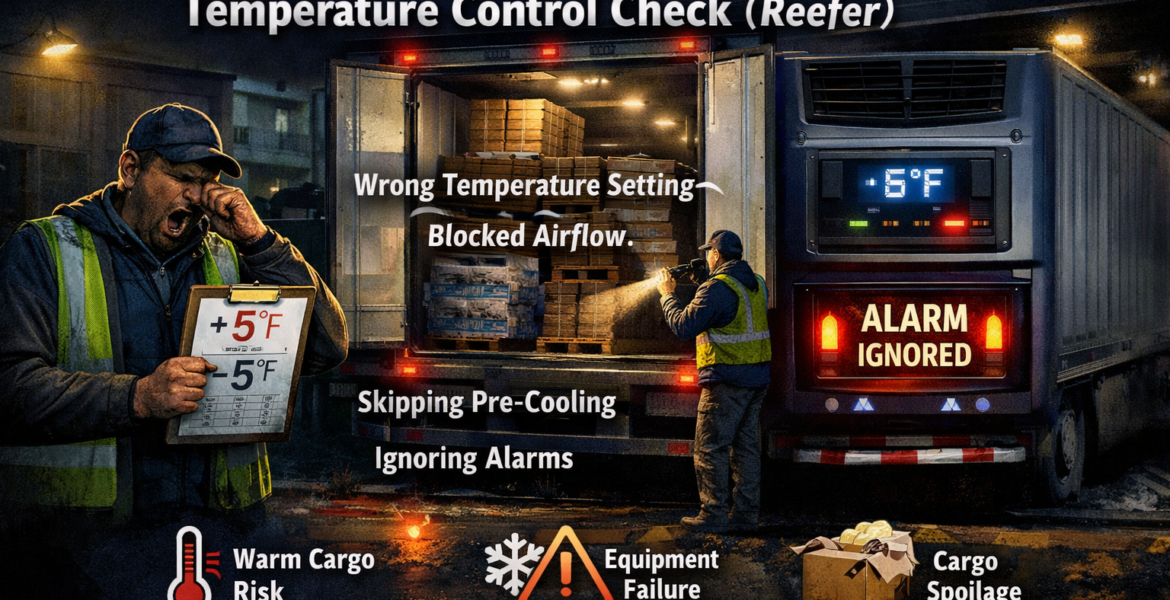
1. Wrong Temperature Settings
The most frequent reefer error is simply setting the incorrect temperature. This happens by:
- Entering +5°F instead of -5°F for freezing products
- Not changing the load settings from the previous trip
- Misunderstanding between Celsius and Fahrenheit displays
At night drivers are often leaning on their memory instead of being with their paperwork. An incorrect digit can cause a delay that may not be noticed for hours.
2. Skipping the Stabilization Period
Most reefer units need the preloading time to align with the temperature for loading. During the night the loading crew load the units right away, which then traps warm air inside. This leads to long pull-down times and unstable cycles of refrigeration.
3. Poor Airflow Management
Mistakes like:
- Pallets touching the ceiling
- Blocked return air chutes
- Tight rear door stacking
These errors disrupt circulation and cause uneven cooling, even when the reefer unit is functioning correctly.
4. Ignoring Alarm History
Night checks are often those that leave the alarm logs untouched. Those minor alerts that are related to voltage drops, sensor deviations, door openings, and such. They may be early indicators of problems that will soon occur to the reefer. Ignoring these minor indicators, as a matter of fact, leads to unit failure later on the route.
Temperature Control Check Mistakes That Break the Cold Chain
Temperature control is not just an action as it is a process. This process is often interrupted at night.
One of the big flaws is only relying on the setpoint display. The reefer might show that it has the right temperature while the actual product is far from it. This issue of a reefer can happen if:
- The unit is in continuous mode but blocked airflow
- The sensors are icicles or misreading
- The product temperature was never disentangled before it was loaded
Another one is skipping a manual temperature verification check. Infrared checks, probe readings, or pulp temperature confirmations are left in the middle of the night. Drivers are assuming that the refrigeration cycle will “catch up,” but frozen goods do not forgive.
The door-opening duration is another killer here. During the night loading operations, the doors are left longer open in the process of loading which is a slow operation. That means every additional minute will allow unwanted humid air to come in thus increasing the frost buildup.
Finally night’s checks also end up skipping condensation signs. Moisture inside the trailer indicates temperature fluctuation and poor sealing — early indicators of the cold chain being compromised.
High-Risk Night Loading Errors and Their Consequences
| Error Type | What Happens | Operational Consequence |
| Wrong temperature setting | Incorrect refrigeration cycle | Partial thawing, rejected load |
| No pre-cooling | Warm air trapped inside | Long pull-down, unit strain |
| Blocked airflow | Uneven temperature zones | Spoilage despite correct setpoint |
| Ignored alarms | Early unit failure signals missed | Breakdown mid-route |
| Extended door opening | Humidity and frost buildup | Sensor errors, inefficiency |
Reefer Unit Problems That Appear After Night Loading
Many reefer units blamed as “equipment failure” are actually the end result of errors happening during night loading. The unit fails not because it is defective but because it was forced to compensate for improper working conditions.
Some common post-loading issues with the reefer can be:
- Excessive compressor cycling during this time
- The unit being incapable of reaching a target temperature
- Repeated high-return-air alarms
- Frosted evaporator coils
When the reefer unit has to work harder to manage the heat load, its parts get used up faster. The fans, belts, and sensors are strained and this contributes to hyper failure in the trip.
Night loading hides electrical issues as well. The voltage instability in the docks at night may lead to minor shutdowns that pass unnoticed until the unit goes dead. The drivers also miss the early warns without reviewing alarm history.
Hence, the answer to improperly functioning reefer units is always starting with the investigations of the loading conditions. Mechanical diagnostics do not indicate such things as airflow mistakes, wrong temperature settings, or cold chain disruptions caused at the dock.
Preventative Maintenance Practices That Reduce Night Errors
Preventative maintenance does not include just the shop inspections; it also refers to driver habits and loading discipline.
Major actions to take include:
- Always resetting the temperature settings before loading
- Allowing full pre-cooling time regardless of schedule pressure
- Performing a documented night check, not a mental one
- Verifying airflow paths visually, even in low light
Using a checklist consistently protects the drivers from fatigue-driven shortcuts. Many of the fleets which had achieved a decrease in reefer errors did it not by buying new equipment, but by standardizing night loading protocols.
Calibration checks for the sensors are also a life saver. A reefer unit with fluctuating sensors passes a false sense of security. Regular calibration gets rid of the hidden temperature fluctuation issues.
More to the point, drivers should view the alarm logs as diagnostic tools and just not background noise. Night loading demands more attention and care, not less.
Night Reefer Check — What Must Be Verified Every Time
| Check Item | Why It Matters |
| Temperature setting | Prevents incorrect fermentation mode |
| Pre-cooling completed | Stabilizes transport temperature |
| Airflow clearance | Ensures even cooling |
| Door seal condition | Maintains cold chain integrity |
| Alarm history | Detects early unit failure |
| Actual cargo temperature | Confirms product safety |
Cargo Protection Starts Before the Wheels Move
Cargo protection in refrigerated transport does not start on the road — it starts at the dock especially at night. The most significant losses can often be traced back to the first 30 minutes of loading and the decisions made during this time.
The loading errors during the night compound without being detected. Temperature fluctuations may not be the reason for immediate alarms, but the frozen products react to them slowly. In the end, the damage is irreversible.
Pro drivers of reefers are very much aware that the mastery of temperature control is not determined by speed but by the stability of a machine. Taking the time to carry out full checks and reading the true night check can often save hours of troubleshooting, claims processing, and downtime.
In reefer transport, darkness cannot be treated as an excuse. It really harms visibility.
Final Thoughts: Turning Night Risk into a Systematic Process
The errors in the process of loading at night and checking temperatures are not random; they are repeatable. The elements of fatigue, poor visibility, and time pressure combine to create the same failure patterns again and again, often manifesting later as reefer problems rather than isolated incidents.
The solution is not daredevil driving or just the luck factor. The solution is structure. Clear procedures, disciplined checks, and respect for cold chains turn the night loading reflex from a liability into a controlled process.
Reefer transport rewards stability and regularity. Where temperature settings, airflow, and refrigeration are confirmed every time — especially at night — unit failure is rare, cargo protection becomes more feasible, and drivers become more confident in the way their equipment works.
A proper cold chain is built by each decision enacted one after the other. Night loading simply shows that these decisions need to be more intentional.
Leave a Reply