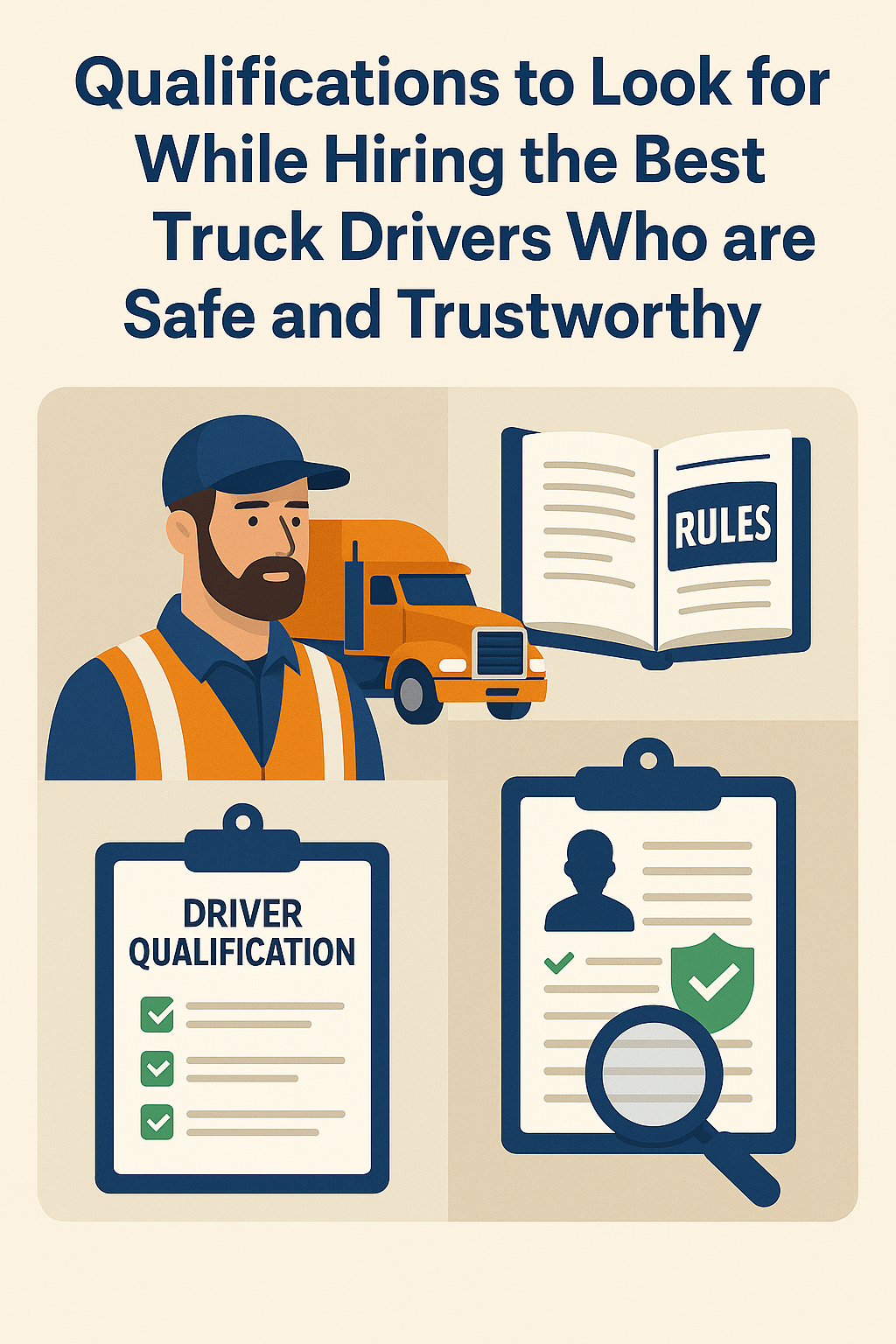
Acquiring safe and reliable truck drivers is becoming more and more important as fleets are facing the waves of driver challenges and the revolutionary changes in safety regulations. The American Trucking Associations (ATA) says that the current market of trucking is short of around 60,000 drivers, and further estimates a shortage of 1.2 million drivers in the next decade which will need to come from replacement hiring due to a very old workforce and the broad freight demand. Besides this, the harmonic compliance depends largely on the perfectly moderated driver qualification files (DQFs) which contain the Obvious Things like road tests and medical exams, and thus prove the candidate’s compliance with Federal Motor Carrier Safety Administration (FMCSA) or similar authoritative rules. This is the crux of the matter, hence, firms are obliged to comprehensively check each applicant through a diversity of skills such as knowledge of licensing, driving history, interpersonal skills, and recent performance.
Knowledge of the Required Rules
A fundamental step before taking a look at resumes is to base your hiring process on FMCSA’s minimum qualifications which are set forth in 49 CFR § 391.11. As per this rule, a qualified driver has to be a minimum of 21 years old, be able to demonstrate adequate English language skills to interpret traffic signs, hold conversations with the official people and write reports, have the experience or training to operate the vehicle safely, fulfill the physical and medical requirements, carry a valid CDL from only one jurisdiction, and complete a driving test. Therefore, any prospective driver failing even one of these is disqualified by default and that is why verifying the regulatory compliance is a must before going into further assessments.
Driver Qualification Files

A full DQF form apart from highlighting legal eligibility doubles as a reference point in a company’s journey towards the acquisition of safe truck drivers. In a nutshell, the following are the crucial records that trucking companies are to keep and manage:
| Documents | Regulations | Storage Period |
| Driving Record Check with State Agencies | 49 CFR 391.25(a), (c) | 3 years from date of execution |
| Annual Review of Driving Record | 49 CFR 391.25(c)(2) | 3 years from date of execution |
| Driver’s Annual List of Violations | 49 CFR 391.27 | 3 years from date of execution |
| Medical Examiner’s Certificate | 49 CFR 391.43 | 3 years from date of execution |
| Driver’s Application for Employment | 49 CFR 391.21 | Duration of employment + 3 years |
| Road Test Certificate or Equivalent | 49 CFR 391.31(e) | Duration of employment + 3 years |
| Previous Employer Safety Performance Records | 49 CFR 391.23(a), (b) | Duration of employment + 3 years |
Having and checking these documents regularly goes not only to the saving of costs but to the clarity of each applicant’s situation concerning the law and their prior performance as well.
Facilitating History of Driving and Safety Records
The Motor Vehicle Record (MVR) of a candidate expedites a check into their day-to-day driving style. As per FMCSA regulations, carriers should draw an MVR for the last three years from a newly hired worker and continue to do so yearly afterward in order to identify disqualifying citations like DUI, serious driving violations, or the number of accidents that are chargeable. Like that, the FMCSA’s Compliance, Safety, Accountability (CSA) setup being more straightforward now with the violation types and severity levels it can be easy to distribute the scores to drivers who match the company’s standards making it even easier for the carrier to identify them. The most effective method in ensuring infallible honesty on both sides will be that the self-reports should be regularly compared with the official MVR.
Background Checks and Drug & Alcohol Testing
Besides driving skills, a thorough examination of a possible driver’s actual background, including criminal records and prior employment due diligence, helps to assure the reliability of the candidate. Equally important is the double-check with the FMCSA’s Drug & Alcohol Clearinghouse. Starting November 18, 2024, any money “prohibited” folks including those who either fail or refuse drug testing will have the CDL immediately downgraded. The driver will get his/her CDL back only after he/she completes the Return-to-Duty protocol. Besides these, setting questions to candidate(s) regarding prior charge and then checking the Clearinghouse data to confirm that nothing dodgy happened keeps the fleet away from potential costs incurred via accidents and also communicates to the applicants the safety parameter is a must.
Main Skills, Instruction, and Background
Safe truck drivers are not only the ones having a CDL, however, but they are also ones who go the extra mile by being equipped with an appropriate skill set that your operation requires. Per 49 CFR § 391.11(b)(3) section, the driver must show, through either experience or training, the ability to operate the specific vehicle in question effectively. For the new drivers, the FMCSA requires proof through the standardized training certificate to be issued before they are allowed to operate a CMV. This makes sure that all truck drivers get the same basic skill training. Where a role requires certificates such as endorsements for hazardous material and tankers, and double trailers the programs become even more specific. What about getting on board with carriers to the Safe Driver Apprenticeship Pilot (SDAP) Program? In such turnkey apprenticeship programs, the kids between 18 and 20 can work and gain supervised experience without compromising safety.
Language Skills and Communication
If truckers master the communication rule, they would contribute to safety on the roads. In the current FMCSA permission framework, the applicants have to “read and speak English language sufficiently to converse with the general public, understand traffic highway signs and signals, respond to official inquiries, and make entries on reports and records.” Besides that, if by the 25 of June 2025 they fail to prove that, which may lead to being out-of-service orders during inspections, they will turn the early language screening into a step of risk management.
Evaluation of Soft Skills and Technological Knowledge
The mentioned flaws above, not only regulations and files but moreover, hops bring the right people who tank the best of them; steadfastness, flexibility, and a forward perception. Find the candidate who displays strong problem-solving skills, is polite to customers and has a documented history of arriving on time. Nowadays, having advanced knowledge about telematics, ELDs, and AI Q-CAM, is a vital requirement for a prospective driver. The platforms such as Trucking Talent have in them features for performance metrics profile drivers by delivery performance, fuel efficiency, which in turn help you quickly locate the drivers who show safe performance.
Returning Support and Monitor
The process of hiring safe truck drivers involves not just on-boarding alone. The continuous supervision that comes from telematics systems, regular assessments, and refresher trainings assures that safety remains paramount. The FMCSA through CSA’s 2025 updates grouped related violations and made the time it takes to earn score relief after 12 months of clean records shorter which carries had as an incentive to maintain good health. They also benefited drivers who follow the rules consistently. One of the ways this can be achieved is by Driver Wellness programs and mentorships, for example, by linking newbies with experienced SDAP mentors. This way a culture emerges that cannot be imagined without safe and reliable driving.
Summary
The appropriate choice of drivers for your company is a multimodal approach; like checking strictly regulatory compliance, examining driving records, to focusing on basic abilities, language, and performance. By observing FMCSA legal requirements, the use of apprenticeship programs, and tech-based strategies such as looking to hire truck drivers, you will be getting drivers who not only meet the required standards but also excel in them. In the period of labor shortage and tough regulations, these qualifications assure success on the road and every truck drives year sustainable.
Leave a Reply